
Maradona, Malayalis, and the Amalfi Coast
Written for the Pushpagiri college magazine, this short travel reflection captures a spare afternoon in Positano on the Amalfi Coast — from cliffside stairways and seaside views to football celebrations and an unexpected Malayali encounter in southern Italy.
TRAVEL
2/3/20264 min read
I had only ever heard of the Amalfi Coast through Hollywood frames — yachts gliding into secret coves and celebrities stepping onto sunlit terraces. It always felt distant from my usual travel plans. So when I found myself with a free day in Italy after attending a conference inRome — the same city from where I would soon fly back to Kerala — I barely hesitated. Among the day-tour options, Positano stood out instantly, one of the most iconic towns along the Amalfi Coast.
We set out early in the morning. After a brief stop at Pompeii, we continued south, reaching Positano around 2 pm. Even before entering the town, the journey offered a preview of what lay ahead. From the winding road, we caught a sweeping view of Sorrento — a moment that quite literally took my breath away.
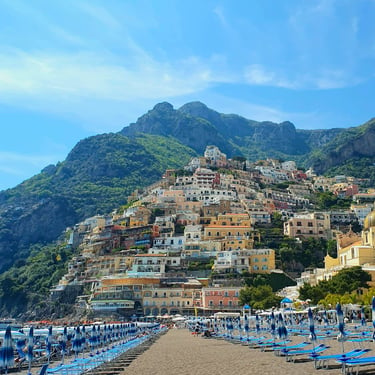
Positano reveals itself gradually. Built into the rugged limestone slopes of the Lattari Mountains, the town unfolds as a dramatic “vertical village.” We parked at the top of the cliff and began our descent toward the beach, passing through narrow stairways and rows of small shops, with every turn offering a fresh perspective of the colourful houses stacked along the hillside. Rising sharply from sea level, the terrain amplifies its visual drama. The town feels almost unreal — like a carefully composed painting. It is hard to find a single corner without a postcard-worthy view: pastel facades cascading down the cliffs, the tiled dome of the Church of Santa Maria Assunta below, and the endless blue of the Mediterranean stretching beyond.
At the base of this cliffside settlement lies Marina Grande beach. Much of it was covered with neatly arranged sun loungers. Sunbathing is not exactly a habit most of us back home willingly embrace, but I did feel left out in not knowing how to swim well enough to have the confidence to wander into the water. Boats moved constantly across the bay, and there were plenty of water activities on offer, but the afternoon sun was simply too strong for me to linger long.
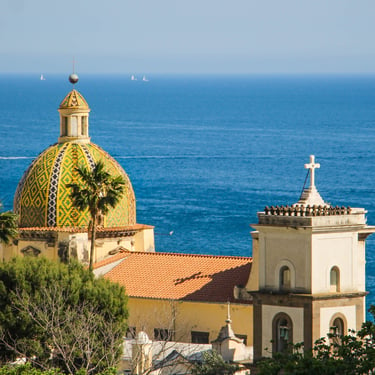
Just steps away from the beach stands one of Positano’s most photographed landmarks — the Church of Santa Maria Assunta. Its most striking feature is the dome, covered in vibrant yellow, green, and blue majolica tiles that gleam against the coastal sky. Inside, the high altar houses a famous thirteenth-century Byzantine icon of the Madonna, adding a quiet historical depth to the otherwise lively seaside atmosphere.
Seeking refuge from the heat, I slipped into a small cliffside café and asked the owner to suggest something special. She returned with a bottle of Polara Melograno Antica Ricetta Siciliana — a sparkling, non-alcoholic pomegranate drink — paired with a dome-shaped sponge cake called Delizia al Limone, or Lemon Delight. The combination was refreshingly simple and perfectly local.
In Positano, the streets are lined with boutique stores featuring sandals, limoncello, ceramics, and linen clothing. Limoncello, a popular sweet and fragrant Italian lemon liqueur traditionally produced in Southern Italy, is exclusive to the region and highly recommended. So I walked into one such shop selling sandals, limoncello, ceramics, linen clothing, and other souvenirs — the typical tourist traps.
There was this guy in his early twenties wiping the floor, seemingly the only staff there. Though he didn't look exactly Italian, I greeted him and gestured that I'd browse around first. A few other people walked in shortly after, and I saw him busy fixing and serving drinks for them. After selecting a few souvenirs and a bottle of limoncello, I walked up to him to bill the items. He asked me in English where I was from.
In Rome, the presence of Indians and fellow Malayalees was a familiar sight, but as I moved toward Pompeii and Positano, diverse faces became a rarity. I realized I was one of the few travellers from my part of the world there, and he was curious. I replied I was from Kerala, the southern part of India.
He smiled at me and said, "Ivide joli cheyyuvaano?"
I was taken aback to hear Malayalam. Now when I looked at him more closely, he did have typical Malayali facial features. He was from Ernakulam and had been in Italy for nearly two years, working in various shops across major towns along the Amalfi Coast. Spotting my camera, he asked me to take a few photos of him behind the counter, posing with items from the shop. We exchanged email addresses, and I promised to send him the pictures once I returned home. As I stepped out, I couldn’t help but smile at the familiar realisation: no matter where you travel, you are never too far from a Malayali.
If you have enough room in your suitcase — and a generous travel budget — Positano offers countless stores selling high-quality local products. I had neither, so I walked around capturing photos of the stores, facades, and cliffs, all vividly painted and bright.
One detail repeatedly caught my attention — blue and white celebratory banners across shop fronts, parking areas, and public spaces reading “Napoli Campione D’Italia.” Curious, I asked our guide about it. It turned out I had arrived during a historic moment in Italian football. The football club from the nearby city of Naples, SSC Napoli, was winning the Serie A title after a gap of 33 years. For a generation of fans, this was a once-in-a-lifetime event.
In Italian football, wealthy northern clubs such as Juventus, AC Milan, and Inter Milan have traditionally dominated. A win for a southern club like Napoli is seen as a triumph for the underdog and a point of immense regional pride. I am not particularly a follower of football other than during the World Cups, and if asked to name current or past footballers, I might be able to count them on my fingers. One such name is Maradona. And guess who led SSC Napoli to their only two previous Serie A titles? Maradona.
As the afternoon faded, it became clear that Positano — and the Amalfi Coast as a whole — demands time. It is not a place meant to be rushed through on a tight schedule. Ideally, it deserves slow exploration, unhurried boat rides, quiet cafés, and long pauses simply to sit and absorb the view. Perhaps someday, with more time in hand, I will return — not just to see Amalfi again, but to finally experience it at its own pace.
Joe Abraham
Sharing thoughts on books, films, travels and public health.
© 2025. Joe Abraham. All rights reserved.